

The Pirates are (maybe) trying!
Taking a look at some of the moves the Pittsburgh Pirates did and did not make, and what it could mean for their future.

The Pittsburgh Pirates have often been seen as a hopeless franchise. They play in one of the smallest markets, have one of the poorest owners and have not earned a postseason berth since 2015. Even though the Pirates have been lucky enough to land a generational talent like Paul Skenes, the conversation surrounding his future is usually focused on potential trades and the belief that he will inevitably be too expensive for the Pirates to sign once he eventually reaches free agency.
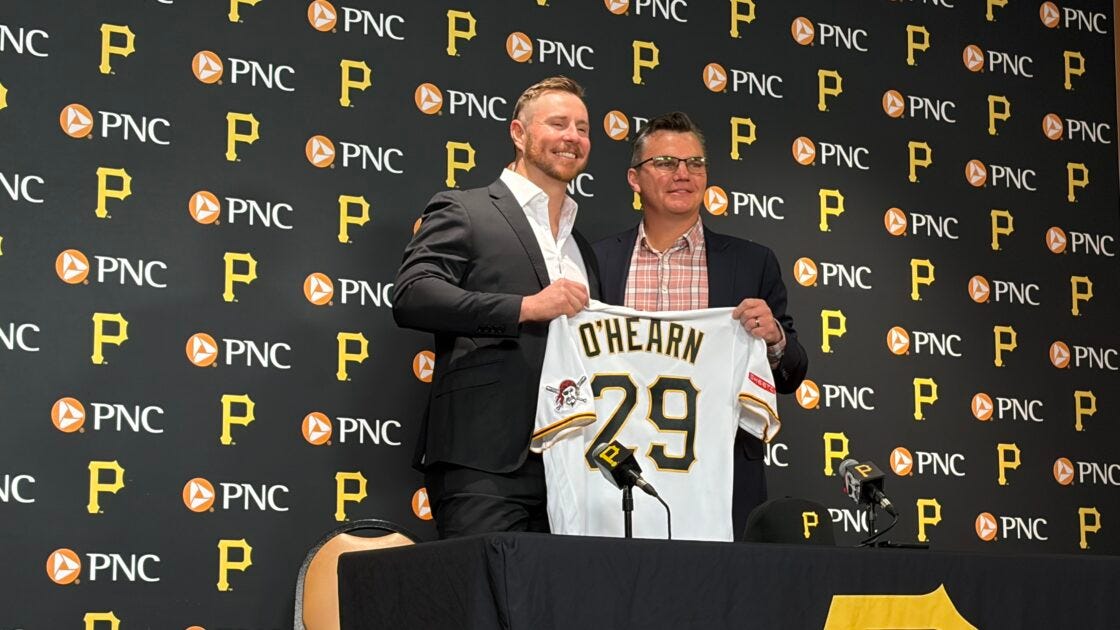
But this offseason, there has been a palpable difference in the way the Pirates have operated. When they signed first baseman/outfielder Ryan O’Hearn to a two-year, $29 million deal in December, it was the first multi-year deal the team has given to a free agent since starting pitcher Ivan Nova was signed to a three-year, $26 million contract in 2016.
Even though O’Hearn’s $29 million is still just below Francisco Liriano’s franchise record $33 million free agent contract that he signed in 2014, the Pirates have still had a net positive offseason. The Buccos made meaningful additions and have at least reportedly made good faith efforts to try and sign some of the big name free agents.
Here’s a quick recap:
In a three-team trade with the Tampa Bay Rays and Houston Astros, the Pirates acquired two-time All-Star second baseman Brandon Lowe and speedy outfielder Jake Mangum from the Rays in exchange for sending pitcher Mike Burrows to the Astros.
The Pirates sent righty Johan Oviedo to the Boston Red Sox for outfield prospect Jhostynxon Garcia, aka “The Password,” who is now ranked as the team’s No. 5 prospect per The Athletic’s Keith Law.
In free agency, the Pirates agreed to deals with O’Hearn, lefty reliever Gregory Soto (one-year, $7.75 million), right-hander Jose Urquidy (one-year, $1.5 million) and the recently acquired designated hitter Marcell Ozuna (one-year, $12 million), who is just one season removed from a 39 homer and .924 OPS season in which he finished fourth in NL MVP voting.
This is a significant improvement. Lowe and Ozuna have legitimate 30+ home run power. Mangum provides elite defense and baserunning. The 23-year-old Garcia could quickly become a fan-favorite and has a very promising offensive profile. No one would argue that Soto and Urquidy are in their primes, but they are veterans who have been a part of winning teams and can help stabilize a young pitching staff.
Despite these additions, the more relevant indicator about the Pirates’ desire to be competitive has been the players they failed to sign. Throughout the offseason, they have reportedly been connected to top free agents Kyle Schwarber, Eugenio Suarez and Framber Valdez.
After Schwarber signed back with the Philadelphia Phillies for five years and $150 million in December, Alex Stumpf, formerly of MLB.com, reported that the Pirates offered him a four-year, $125 deal. Stumpf also reported that the Pirates offered Suarez a one-year, $15 million contract, the same figures that he ended up accepting with the Cincinnati Reds. The Athletic’s Ken Rosenthal reported that the Pirates “emerged as one of the most aggressive clubs” during the late stages of Valdez’s free agency before he eventually signed a three-year, $115 million contract with the Detroit Tigers.
Does this mean anything though? The Pittsburgh Post-Gazette’s Noah Hiles does not necessarily think so. He recently made an appearance on Foul Territory, and was asked by A.J. Pierzynski about the Pirates potentially needing to overpay for top free agents because of the organization’s reputation and said, “you don’t get credit for offering the same thing everyone else is.”
I disagree.
The offer the Pirates reportedly made to Schwarber was legitimate. It had a higher average annual value (AAV), $31.25 million, than what he ended up signing with the Phillies, $30 million. Before the offseason began, MLB Trade Rumors’ very well respected contract predictions had Schwarber signing a five-year, $135 million contract, which had just one more year and a significantly lower AAV than what the Pirates offered. The $125 million is also more than triple Liriano’s record free agent contract.
In Suarez’s case, they offered the same one-year, $15 million terms that he ended up getting from the Reds. That likely means that unless they offered something significantly more than the Reds, they were never going to get him. Suarez had already spent seven seasons in Cincinnati, and the hitter-friendly Great American Ballpark is certainly a great place to play a “prove-it” campaign before entering free agency again next offseason.
The specific details regarding the Pirates’ pursuit of Valdez are not known. While there is a chance that the Pirates could have exaggerated their pursuit to the media in order to gain favor with their fans, it does make sense that they could try and capitalize on Valdez’s slow market. The Pirates certainly had the money. Valdez ended up signing with the Tigers for less than the Pirates reportedly offered Schwarber.
The NL Central is looking like one of the weaker divisions in baseball. The Chicago Cubs stayed about the same, swapping Kyle Tucker for Alex Bregman. The Milwaukee Brewers should be competitive like they always are, but lost a lot of talent, even for them, trading away Isaac Collins, Freddy Peralta, Tobias Myers and Caleb Durbin, among others. Even with Suarez, the Reds remain flawed. The Cardinals had a firesale this offseason, moving on from Willson Contreras, Sonny Gray, Nolan Arenado and Brendan Donovan.
There is no reason why the Pirates can not compete for the postseason.
But more importantly, Pirates fans should be optimistic about how the front office has been willing to invest in this team. Players like Skenes do not come around very often. This offseason has shown that there is not only a chance that the Pirates could build a contender around Skenes over the next four seasons before he is expected to enter free agency after the 2029 season, but that they could have a chance to sign him long term.
The Pirates were supposedly willing to open the checkbook for an aging designated hitter like Schwarber and someone like Valdez who has some very real question marks surrounding him, especially after his infamous “cross-up” this past season. It is much more justifiable to spend on a player like Skenes who is already a fan favorite, a consensus top-two pitcher in baseball and one of the most marketable athletes in the world.
Whether it is with the Pirates or another team, Skenes will likely end up signing one of the largest contracts in MLB history. Before this offseason, there was no reason to expect the Pirates to have much of a chance at re-signing or extending Skenes or signing any other big time free agents. But, they tried, and even though they were unsuccessful this time, there is at least a chance they could hit on someone, including Skenes, over the next few years.